Faith and the Holy Spirit
Baptism in the Holy Spirit
By David Boiarsky · November 3, 2026
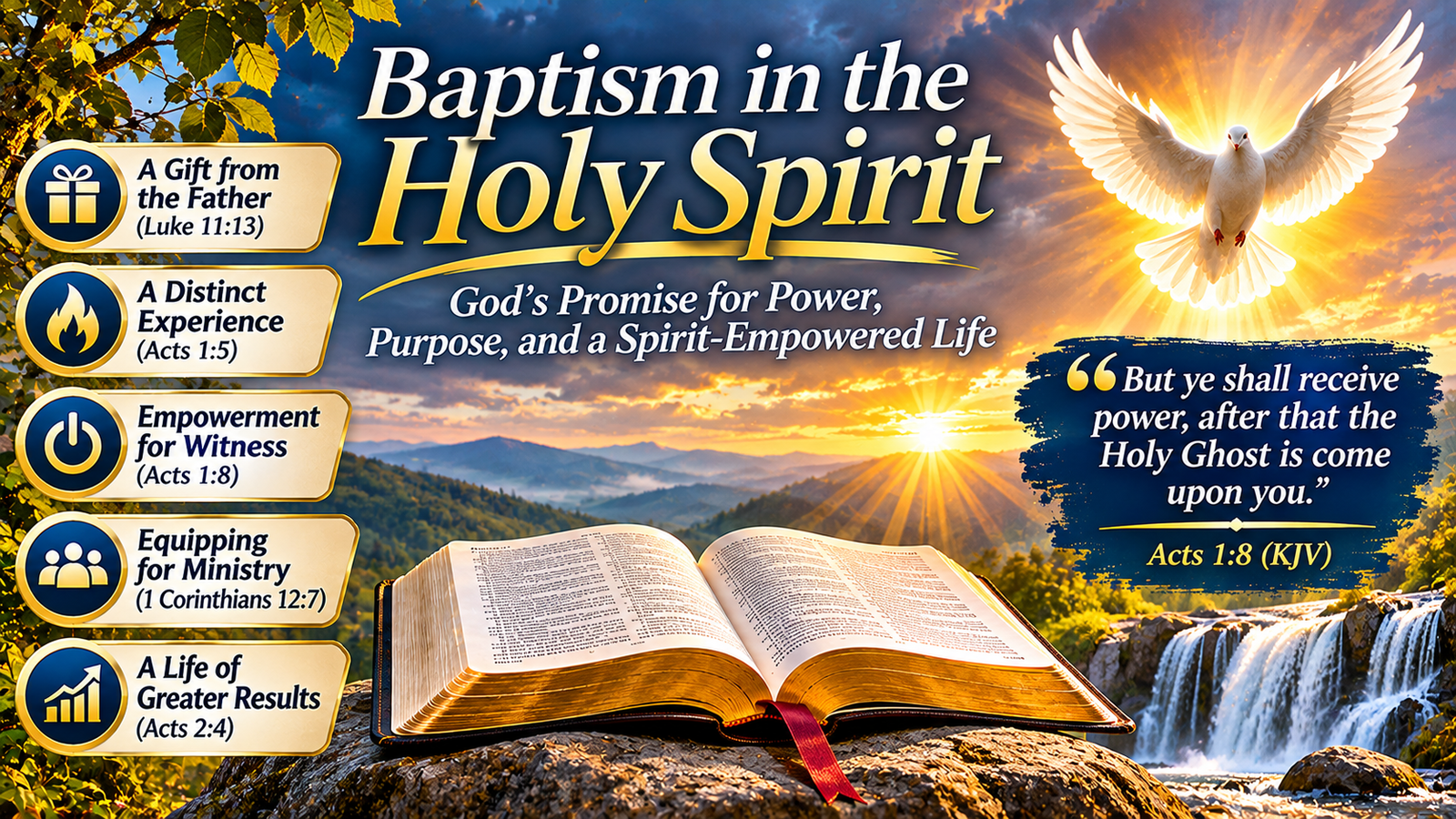
Empowered by the Holy Spirit: God's Promise Is Still for Today Receiving God's Promise, Walking in His Power, and Living in His Purpose
Welcome: You Were Never Meant to Live by Your Own Strength
The Christian life was never intended to be lived through human effort alone. God has provided something far greater than our natural ability, personal determination, or religious knowledge. He has given us the Holy Spirit.
Before Jesus returned to the Father, He made a remarkable promise to His disciples. He told them that they would receive power when the Holy Ghost came upon them. He was not sending them into the world to fulfill a divine assignment using nothing more than their own strength. He was promising them supernatural empowerment to accomplish what they could never accomplish through human ability alone.
That same promise deserves our attention today.
Perhaps you have heard about the baptism in the Holy Spirit but have never personally experienced it. Maybe you have questions about speaking in tongues, spiritual gifts, or what it means to be filled with the Spirit. Or perhaps you have experienced the power of the Holy Ghost but want a deeper understanding of His work in your life.
Wherever you are in your spiritual journey, approach this subject with an open heart and a willingness to examine the Scriptures.
The Holy Ghost is not an emotional experience we manufacture, a religious expression we imitate, or an impersonal force we attempt to control. He is the Spirit of God. He works in believers to reveal Christ, develop spiritual character, empower Christian witness, and equip the Church for ministry.
God never intended for His people to merely know about His power. He intended for them to depend upon His Spirit as they fulfill His purposes.
Primary Scripture
But ye shall receive power, after that the Holy Ghost is come upon you: and ye shall be witnesses unto me both in Jerusalem, and in all Judaea, and in Samaria, and unto the uttermost part of the earth. — Acts 1:8 (KJV)
Consider the setting of this promise. Jesus had been crucified, buried, and raised from the dead. He had spent time with His disciples after His resurrection, teaching them about the Kingdom of God. Now He was preparing to return to the Father.
His disciples had received an assignment, but before they began their public ministry, Jesus instructed them to wait for the promise of the Father.
Why?
Because the assignment required more than natural ability. They needed supernatural power.
Jesus said, "Ye shall receive power." The word translated power is the Greek word *dynamis*, referring to power, might, or ability.
This was not a promise that the disciples would become more impressive personalities. It was a promise that the Holy Spirit would empower them to become effective witnesses of the risen Christ.
Notice the purpose Jesus identified: "Ye shall be witnesses unto me."
The power was connected to a purpose. They would proclaim the Gospel, demonstrate the reality of the risen Christ, and carry the message of salvation beyond the boundaries of their familiar surroundings.
That assignment began in Jerusalem, extended throughout Judea and Samaria, and ultimately reached the nations.
The same principle is important for us today. The Holy Spirit empowers believers not to draw attention to themselves, but to make Jesus known.
The power of the Holy Spirit is not given to make us famous. It is given to help us fulfill God's purposes.
1. Understanding the Promise of the Holy Spirit
Read Acts 1:4–8.
Jesus instructed His disciples not to depart from Jerusalem but to wait for the promise of the Father.
This instruction is significant. These men had walked with Jesus, heard His teaching, witnessed miracles, and seen Him after His resurrection. Yet Jesus told them there was something more they needed before moving forward with their assignment.
He said:
For John truly baptized with water; but ye shall be baptized with the Holy Ghost not many days hence. — Acts 1:5 (KJV)
Jesus identified an experience He called baptism in the Holy Ghost.
The word baptism carries the meaning of immersion. Jesus was describing a divine work in which believers would be immersed in the Holy Spirit's power for the purpose of service and witness.
Pentecostal Christians understand this baptism as an experience distinct from conversion and regeneration, in which the believer receives empowerment for Christian ministry. They understand speaking in other tongues as the initial physical evidence of this experience.
It is important to recognize that Christians from different traditions interpret certain passages differently. We should study those passages carefully and treat sincere believers with respect. However, we should never allow differences in interpretation to keep us from examining everything God's Word teaches about the Holy Spirit.
The promise of the Holy Spirit was not presented as a reward for a select group of spiritually superior people. It was the promise of the Father, given to equip Christ's followers.
You do not have to become perfect before seeking the Lord. You do not have to understand every aspect of the experience before coming to Him in faith.
Come with an honest heart. Study the Word. Pray with expectancy. Trust the goodness of your Heavenly Father.
The Holy Spirit is God's gift, not a prize we earn through religious performance.
2. Pentecost: When the Promise Became a Reality
Read Acts 2:1–18.
The day of Pentecost marked a significant moment in the history of the Church.
The disciples were gathered together in one place when suddenly there came a sound from heaven as of a rushing mighty wind. Cloven tongues like as of fire appeared, and they were filled with the Holy Ghost.
The Bible tells us:
And they were all filled with the Holy Ghost, and began to speak with other tongues, as the Spirit gave them utterance. — Acts 2:4 (KJV)
Notice several important details.
First, the experience originated with God. The disciples did not manufacture the sound, create the manifestation, or generate the power through human effort.
Second, they were filled with the Holy Ghost.
Third, they spoke with other tongues as the Spirit gave them utterance.
This was not simply an emotional gathering. Something supernatural had taken place, and the result was immediately visible.
People from different nations heard the disciples speaking in languages they recognized. Peter then stood and boldly proclaimed the Gospel of Jesus Christ.
Remember that Peter had previously denied knowing Jesus. Yet now he stood before a crowd and preached with courage and conviction.
What had changed?
The resurrection of Jesus was the foundation of his message, and the promised Holy Spirit had empowered the disciples to become witnesses.
The same Peter who had once been intimidated by a servant girl now boldly proclaimed Christ before a multitude.
This is one of the remarkable truths of Pentecost: God can empower ordinary people to accomplish extraordinary things for His Kingdom.
Pentecost was not the end of the promise. It was the beginning of a new era of Spirit-empowered witness.
3. The Baptism in the Holy Spirit Is for Believers Today
Read Acts 2:38–39.
After Peter preached on the Day of Pentecost, the people were convicted and asked what they should do.
Peter responded:
Then Peter said unto them, Repent, and be baptized every one of you in the name of Jesus Christ for the remission of sins, and ye shall receive the gift of the Holy Ghost. — Acts 2:38 (KJV)
Then Peter continued:
For the promise is unto you, and to your children, and to all that are afar off, even as many as the Lord our God shall call. — Acts 2:39 (KJV)
Notice the language Peter used: "The promise is unto you."
He did not present the promise as something that would disappear with the first generation of believers.
He spoke of the promise extending beyond those who were standing before him.
Throughout the book of Acts, we find additional accounts of believers receiving the Holy Spirit and experiencing His supernatural work.
Consider:
- Acts 8:14–17 — Believers in Samaria received the Holy Ghost. - Acts 9:17 — Ananias ministered to Saul so that he might receive his sight and be filled with the Holy Ghost. - Acts 10:44–46 — The Holy Ghost fell upon Cornelius and his household, and they spoke with tongues. - Acts 19:1–6 — Disciples in Ephesus received the Holy Ghost and spoke with tongues and prophesied.
These passages demonstrate that the work of the Holy Spirit was not confined to the original group of disciples.
Pentecostal believers understand these accounts as evidence that God's promise continues for believers today.
We should not build our expectations upon isolated experiences or human traditions. We should build them upon the whole counsel of Scripture.
If God has made a promise, we should never be ashamed to seek to understand it and receive what He has provided.
4. Spiritual Gifts: Equipped to Minister to Others
But the manifestation of the Spirit is given to every man to profit withal. — 1 Corinthians 12:7 (KJV)
The Holy Spirit does more than empower believers to witness. He also equips the Church through spiritual gifts.
First Corinthians 12 describes manifestations of the Spirit that include:
- The word of wisdom. - The word of knowledge. - Faith. - Gifts of healing. - Working of miracles. - Prophecy. - Discerning of spirits. - Divers kinds of tongues. - Interpretation of tongues.
These gifts are not human achievements. They are manifestations of the Holy Spirit's work.
Paul makes something very clear:
But all these worketh that one and the selfsame Spirit, dividing to every man severally as he will. — 1 Corinthians 12:11 (KJV)
The Spirit distributes gifts according to His will.
We should desire to be useful in the Kingdom of God, but we must never treat spiritual gifts as trophies or use them to establish our importance.
Their purpose is to build up the Church and minister to people.
The gifts of the Spirit should always operate in harmony with God's Word and the character of Jesus Christ.
Paul devoted an entire chapter, 1 Corinthians 13, to explaining the importance of love in the exercise of spiritual gifts.
Without love, even the most impressive spiritual manifestation loses its proper purpose.
We should never allow spiritual experiences to become an excuse for pride, manipulation, disorder, or spiritual control.
The true purpose of spiritual gifts is not to elevate the person ministering, but to bless the people receiving ministry.
5. The Gifts of the Spirit and the Fruit of the Spirit
Read Galatians 5:22–23.
There is an important distinction between spiritual gifts and spiritual fruit.
Spiritual gifts describe the ways the Holy Spirit equips believers for ministry.
Spiritual fruit describes the character qualities He develops in our lives.
Paul identifies the fruit of the Spirit as:
- Love. - Joy. - Peace. - Longsuffering. - Gentleness. - Goodness. - Faith. - Meekness. - Temperance.
We should desire the gifts of the Spirit, but we must also allow the Spirit to develop His fruit in us.
A person may demonstrate spiritual gifting while still needing growth in patience, humility, or love.
Spiritual maturity requires more than supernatural manifestations. It requires a life increasingly reflecting the character of Jesus.
The power of the Holy Spirit and the character of Christ should never be separated in our understanding of Christian living.
We need both.
We should desire to see the sick healed, the oppressed delivered, the Gospel preached with power, and spiritual gifts operating according to Scripture. But we should also desire to see believers walking in love, integrity, humility, and holiness.
Spiritual power without Christlike character is not the complete picture of the Spirit-filled life.
6. Receive God's Promise Without Fear or Pressure
Perhaps you have been seeking the baptism in the Holy Spirit but have not experienced what you expected.
Maybe someone has told you that you must speak in tongues immediately or that something is wrong with your faith.
I want you to understand something important: You should never have to pretend to receive what only God can give.
The Holy Spirit is not received through imitation, emotional manipulation, or pressure from another person.
Jesus gave us an encouraging picture of the Father's goodness:
If ye then, being evil, know how to give good gifts unto your children: how much more shall your heavenly Father give the Holy Spirit to them that ask him? — Luke 11:13 (KJV)
Think about the goodness of that promise.
Jesus directed His followers toward the Father, who delights in giving good gifts.
Come to God with confidence in His goodness.
Ask Him to fill you with the Holy Spirit. Study the Scriptures. Pray with expectancy. Be willing to respond to His leading.
Do not compare your experience with someone else's. Do not measure God's love by the intensity of an emotional moment.
At the same time, do not allow fear, confusion, or the opinions of others to keep you from studying and seeking what Scripture teaches.
You can approach this subject with both faith and discernment.
Seek the Giver, not merely the experience. Desire God's power, but always keep Jesus Christ at the center.
7. Live a Spirit-Empowered Life
The baptism in the Holy Spirit should never be treated as an isolated event that has no connection to the rest of our Christian walk.
God's desire is that we live in dependence upon His Spirit.
That means being willing to speak when He gives us an opportunity to witness, to pray for those who are hurting, to serve when there is a need, and to obey God's Word even when obedience is difficult.
It means refusing to rely exclusively upon our natural abilities when God has provided supernatural help.
The Spirit-filled life is not simply about what happens in a church service. It is about how we live when we leave the building.
Our homes, workplaces, relationships, conversations, and daily decisions should reflect our dependence upon God.
Remember the words of Jesus:
Ye shall receive power, after that the Holy Ghost is come upon you: and ye shall be witnesses unto me. — Acts 1:8 (KJV)
That promise still challenges us.
The world does not simply need more religious activity. It needs believers who know Jesus, believe His Word, walk in His Spirit, and are willing to demonstrate His love and power.
God has called us to be more than spectators of what He is doing. He has called us to participate in His purposes through the power of His Spirit.
Reflection Questions
1. Have I developed a personal understanding of what Scripture teaches about the Holy Spirit? 2. Am I depending upon my natural strength or seeking the Spirit's empowerment? 3. What does Acts 1:8 teach me about the purpose of receiving power? 4. Am I seeking spiritual gifts so that I can serve others? 5. Is the fruit of the Spirit becoming increasingly evident in my character? 6. Have fear, confusion, or the opinions of others kept me from honestly seeking God's promise?
Take time to study these Scriptures. Ask questions. Pray. Allow God's Word to establish your understanding.
A Prayer for the Holy Spirit's Empowerment
Heavenly Father,
Thank You for the gift of Your Holy Spirit. Thank You that You have not called me to live the Christian life through my own strength and ability.
I desire to know You more deeply and understand everything Your Word teaches about the Holy Spirit.
Father, fill me with Your Spirit. Empower me to be a faithful witness of Jesus Christ. Give me boldness to speak Your truth, compassion to minister to others, and wisdom to walk according to Your Word.
I desire the gifts of the Spirit so that I can be useful in Your Kingdom. Develop the fruit of the Spirit in my life so that my character reflects Jesus.
Remove fear, confusion, pride, and anything that would keep me from walking in obedience to You.
Teach me to depend upon Your Spirit every day. Let my life bring glory to Jesus Christ.
In His mighty name, Amen.
Final Encouragement: The Promise Still Stands
The promise of the Holy Spirit was not given to make believers feel superior to one another. It was given because God intended His people to be empowered for His purposes.
The disciples needed the power of the Holy Ghost to fulfill their assignment. The early Church needed that same empowerment as the Gospel spread throughout the world.
We need the Holy Spirit's help today.
Do not settle for simply knowing about the promise. Study it. Believe God's Word. Seek the Father. Be willing to respond to the Holy Spirit's leading.
The Christian life is not meant to be lived in the limitations of human strength.
God has provided His Spirit to help us live, serve, witness, and fulfill His purposes.
The promise was made by God. The power comes from Him. The glory belongs to Jesus Christ.**
The promise still stands!
Everyday Application
- Read Acts 1:1–8 and Acts 2:1–18. Notice what these passages reveal about the Spirit and the spread of the gospel.
- Ask God for fresh empowerment to witness and serve. Pray honestly, without trying to force a particular feeling or response.
- Study 1 Corinthians 12–14 with a trustworthy Christian leader, considering gifts alongside love, discernment, and orderly worship.
- Choose one practical opportunity to serve someone or speak about Jesus this week. Depend on the Spirit while respecting the other person's freedom.
Closing Encouragement
You do not have to compete for God's attention or imitate another believer's experience. Seek Him sincerely, stay rooted in Scripture, and welcome His help. The Spirit equips God's people to make much of Jesus, not themselves.
Reader Comments
Please be kind, stay on topic, and protect other people's privacy. No harassment, advertising, or spam. Comments are reviewed before appearing. Community guidelines
No comments yet.
Related Teachings
FAITH IN ACTION - JONAH - BOOK 6
Discover what Jonah teaches about obedience, repentance, God's mercy, and compassion. Learn how to stop running from God's direction and allow Him to change your heart.
FAITH IN ACTION - NOAH - BOOK 1
Discover how Noah's faith, obedience, and perseverance teach us to trust God's Word, remain faithful, and follow Him when the future is uncertain.