Faith and the Holy Spirit
FAITH IN ACTION - NOAH - BOOK 1
By David Boiarsky · November 5, 2026
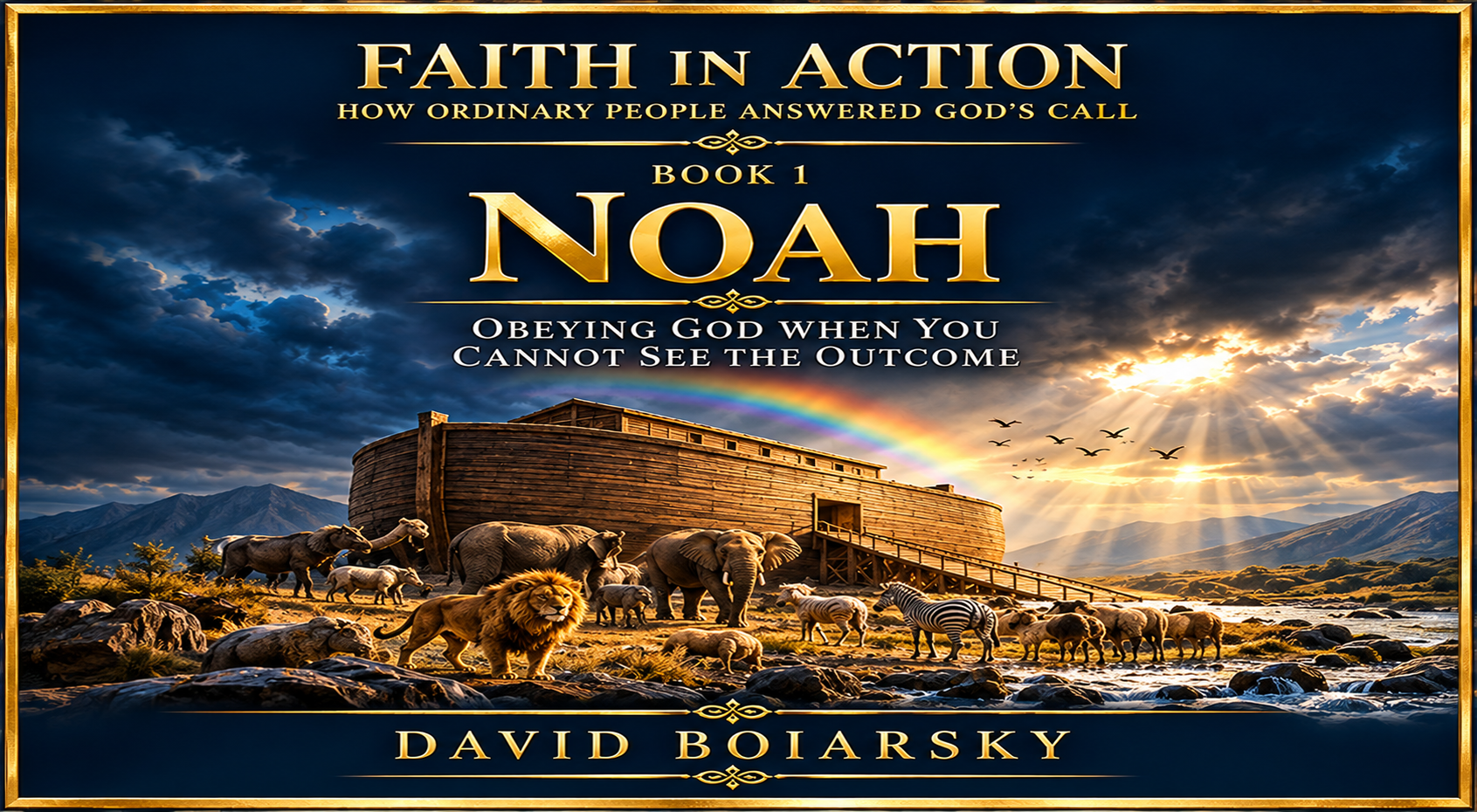
Noah: Obeying God When You Cannot See the Outcome
Learning to Trust God's Word When the World Does Not Understand
There are times in life when obeying God requires us to move forward without knowing exactly how things will turn out. We may not understand the timing, see the outcome, or even have the support of those around us. Yet faith calls us to trust God's character, take His Word seriously, and remain obedient even when the future is uncertain.
Few biblical examples illustrate this truth more powerfully than Noah.
Noah lived in a generation that had turned away from God. Violence, corruption, and wickedness had become widespread throughout the earth. The culture around him had abandoned the principles of righteousness, and humanity had moved far from the purposes of its Creator.
Yet in the middle of this darkness, Scripture introduces us to a man who was different.
Genesis 6:8–9 (KJV) tells us:
"But Noah found grace in the eyes of the LORD.
These are the generations of Noah: Noah was a just man and perfect in his generations, and Noah walked with God."
Before Noah ever built an ark, he had established something far more important: a relationship with God.
He walked with God in a generation that had chosen another direction.
That is where Noah's story begins, and it is an important place for us to begin as well. We can become so occupied with discovering what God wants us to do that we overlook the importance of walking closely with Him. We want to know our assignment, understand our future, and discover what comes next. But before there is an assignment, there must be a relationship.
Noah's obedience did not begin with a construction project. It began with a life lived before the Lord.
Notice also that Scripture says Noah found grace in the eyes of the Lord. His righteousness was not a claim that he was sinless or that he had earned God's favor. He was a recipient of grace who responded by living faithfully before God.
That is an important distinction. We do not obey God to purchase His love. We respond to His grace because He is worthy of our trust.
Jesus said in John 14:15 (KJV):
"If ye love me, keep my commandments."
Obedience is one of the ways our love for God becomes visible.
When God Speaks, We Must Be Willing to Listen
The world in Noah's day had become so corrupt that God revealed His judgment was coming. The earth was filled with violence, and the consequences of humanity's rebellion were about to become a reality.
God gave Noah an extraordinary assignment.
Genesis 6:13–14 (KJV) records God's instructions:
"And God said unto Noah, The end of all flesh is come before me; for the earth is filled with violence through them; and, behold, I will destroy them with the earth.
Make thee an ark of gopher wood..."
Imagine receiving an instruction like that. Noah was being told to undertake something that would require tremendous time, effort, resources, and perseverance.
God was asking him to prepare for something he had never experienced.
Noah had to decide whether he would take God's Word seriously.
Most of us welcome direction when it agrees with our plans. We appreciate opportunities that fit our schedules, use our abilities, and lead toward outcomes we already desire.
But what happens when obedience requires us to change direction?
What happens when doing what is right becomes inconvenient? What happens when God's Word challenges our priorities, requires sacrifice, or takes us somewhere we never intended to go?
That is where trust becomes more than a statement.
It is easy to say, "I trust God," when everything makes sense. It is another matter to trust Him when we cannot see how everything will work out.
Noah's assignment reminds us that faith is not simply agreeing with what God says. Faith must influence how we respond.
Hebrews 11:7 (KJV) gives us this remarkable testimony:
"By faith Noah, being warned of God of things not seen as yet, moved with fear, prepared an ark to the saving of his house; by the which he condemned the world, and became heir of the righteousness which is by faith."
Notice those words: "things not seen as yet."
Noah acted before he could see the fulfillment of what God had revealed.
That is an important principle of faith. Sometimes obedience must begin before the outcome becomes visible.
We do not have to understand every detail of the journey before we can take the next appropriate step. We do, however, need to distinguish between what God has clearly revealed in Scripture, what we conclude through wisdom, and what we believe He may be impressing upon our hearts.
Noah received specific instructions directly from God, as recorded in Scripture. We should not assume that every dream, impression, opportunity, or strong feeling carries the same authority.
God will never lead us to violate His written Word. Prayer, biblical understanding, godly counsel, and sound judgment are essential when making decisions.
Faith takes God's Word seriously, and wisdom takes discernment seriously.
Building Before You See the Rain
One of the most remarkable aspects of Noah's story is that he began preparing before he saw what was coming.
Think about the commitment involved in building an ark. It was not a small project that could be completed in an afternoon. It required planning, labor, materials, and sustained effort.
Noah could not simply talk about believing God. His faith had to become visible through his obedience.
Genesis 6:22 (KJV) says:
"Thus did Noah; according to all that God commanded him, so did he."
What a powerful statement!
Noah did what God commanded.
He did not merely admire the instructions. He did not simply agree that God's warning was important. He responded.
This is an important distinction in the Christian life. We can hear sermons, read Scripture, discuss biblical principles, and agree with everything we hear. But if the Word never influences our decisions or changes how we live, we have missed something important.
James 1:22 (KJV) says:
"But be ye doers of the word, and not hearers only, deceiving your own selves."
Noah's faith produced action.
He prepared for something he had not yet seen because he trusted the One who had spoken.
There are times when we must prepare faithfully without knowing exactly when the results will appear. A parent invests in a child's future. A believer develops a ministry responsibility. Someone makes an honest decision even when dishonesty would seem easier. Another person continues doing what is right despite discouragement.
We may not see immediate results, but faithfulness still matters.
The important question is not whether we can predict the outcome. It is whether we are responding wisely and faithfully to what God has revealed.
Obedience When Nobody Understands
Noah's assignment was so unusual that it is difficult to imagine the reaction of the people around him.
Second Peter 2:5 (KJV) describes Noah as:
"Noah the eighth person, a preacher of righteousness..."
Noah was not simply building an ark. He was also a witness to a generation that had rejected God.
His life stood in contrast to the corruption around him.
We live in a world where biblical convictions are not always welcomed. Sometimes choosing to live according to Scripture means standing apart from popular opinions, cultural expectations, and the decisions of people around us.
There will be times when doing what is right will not make us popular.
We may be misunderstood. People may question our decisions. Some may criticize our convictions without understanding the reasons behind them.
But we must be careful not to confuse criticism with confirmation. Not every person who disagrees with us is opposing God, and not every difficult assignment is necessarily a divine assignment.
Our responsibility is to remain grounded in Scripture, walk in humility, and demonstrate the character of Christ.
Noah's example reminds us that the behavior of the majority does not determine what is right.
We cannot control the direction of an entire culture, but we can determine the direction of our own lives.
We can choose integrity when dishonesty seems profitable. We can practice forgiveness when bitterness seems justified. We can speak truth without becoming hateful. We can remain faithful when others choose compromise.
Sometimes following God means refusing to follow the crowd.
Faithfulness Requires Perseverance
It is one thing to begin something with enthusiasm. It is another to remain faithful when the work becomes difficult and the results are not immediately visible.
Noah's obedience required perseverance.
The Bible does not give us a detailed construction schedule for the ark, but it does make clear that Noah's assignment involved sustained preparation. He had to remain committed to what God had instructed him to do.
There is a lesson here that many believers need to understand.
We often become discouraged when obedience does not produce immediate results. We pray, take a step of faith, and expect circumstances to change quickly. When they do not, we begin wondering whether anything is happening.
But faithfulness is not measured only by immediate results.
Some of the most important things we do in life require time. Building character takes time. Developing relationships takes time. Raising children requires years of commitment. Growing spiritually requires continued attention to God's Word.
We should not abandon what is right simply because the process takes longer than we expected.
Galatians 6:9 (KJV) encourages us:
"And let us not be weary in well doing: for in due season we shall reap, if we faint not."
Noah's life reminds us that obedience is not always a single moment. Sometimes it is a continuing commitment to do what is right, day after day.
When the Waters Rise, Trust God
Eventually, the time came when Noah and his family entered the ark.
Genesis 7:1 (KJV) records:
"And the LORD said unto Noah, Come thou and all thy house into the ark; for thee have I seen righteous before me in this generation."
Noah had prepared for the coming judgment, but now he had to experience it.
The rain came. The waters increased. The familiar world disappeared beneath the flood.
Imagine what that must have been like.
Noah had done what God commanded, but obedience did not mean he would never experience frightening circumstances.
There is an important truth here that we should not overlook: following God does not mean we will never face difficult seasons.
Faith does not guarantee a life without storms, uncertainty, disappointment, or hardship.
Sometimes we obey God and still face circumstances we cannot control.
Noah could not control the rain. He could not control the rising waters. He could not determine how long the flood would last.
He could trust the God who had instructed him to enter the ark.
That is an important distinction for every believer.
We are responsible for our choices, but we cannot control every circumstance. We should use wisdom, fulfill our responsibilities, and trust God with what lies beyond our control.
Psalm 46:1 (KJV) reminds us:
"God is our refuge and strength, a very present help in trouble."
When circumstances become frightening, we need to remember who God is.
Our confidence is not based on our ability to control everything around us. It is based on the faithfulness and character of the Lord.
Waiting Is Also Part of Faith
One of the less discussed aspects of Noah's experience is the time he spent waiting.
Noah had completed the preparation. He had entered the ark. The flood had come. But he could not simply step outside whenever he wanted.
He had to wait.
Sometimes waiting is one of the most difficult parts of trusting God.
We want answers. We want movement. We want to know when circumstances will change. We want to understand what God is doing and when the next opportunity will come.
But there are seasons when we must learn to remain faithful without having all the answers.
Waiting does not mean doing nothing with our lives. It means recognizing that there are circumstances and outcomes we cannot force.
We can continue to pray, worship, grow in understanding, care for our families, and fulfill our present responsibilities.
We can also resist the temptation to manufacture an answer simply because we are uncomfortable with uncertainty.
Noah's story reminds us that God's timing is not determined by our impatience.
When we cannot change the circumstances, we can still choose how we respond to them.
We can remain faithful.
A New Beginning After the Flood
The flood did not bring Noah's story to an end.
After the waters receded and the earth became suitable for them to leave the ark, God gave Noah another instruction.
Genesis 8:15–16 (KJV) says:
"And God spake unto Noah, saying,
Go forth of the ark, thou, and thy wife, and thy sons, and thy sons' wives with thee."
The man who had obeyed God by building the ark was now being directed to step into a changed world.
Noah's story teaches us that following God is not simply about completing one assignment. It is about continuing to respond faithfully as life unfolds.
There are seasons of preparation, seasons of waiting, seasons of difficulty, and seasons of new beginnings.
Sometimes we become so identified with one season of life that we struggle to recognize when our responsibilities have changed.
A person may spend years raising children and then need to discover new ways to serve when those children become adults. A pastor may retire from regular ministry responsibilities but still have wisdom, experience, and encouragement to offer others. Someone may complete a significant project and begin wondering what comes next.
The end of one season does not mean the end of our usefulness.
We should never assume that our value to God depends on remaining busy or continually launching new projects. But neither should we assume that a completed season means God can no longer use us.
Noah stepped into a world that had been changed by the flood. His next chapter would be different from the one that preceded it.
Our lives also contain transitions.
The important question is whether we remain willing to follow the Lord through them.
After leaving the ark, Noah built an altar unto the Lord and offered sacrifices. Genesis 8:20 records this act of worship.
Noah's response reminds us of the importance of acknowledging God after a difficult season.
It is natural to seek God when we need help. We pray when we are frightened, uncertain, or desperate for direction. But we should also remember to thank Him.
Worship and gratitude should not be reserved for emergencies. They should be part of our daily relationship with the Lord.
Remember God's Faithfulness
Genesis 9 records God's covenant with Noah and his descendants. God promised that a flood would not again destroy all flesh in the manner described in the account, and He gave the rainbow as the sign of that covenant.
Genesis 9:13 (KJV) says:
"I do set my bow in the cloud, and it shall be for a token of a covenant between me and the earth."
The rainbow became a visible reminder of God's covenant promise.
What a beautiful conclusion to this remarkable account!
Noah's story is not simply about judgment, survival, and an ark. It is also a testimony of God's faithfulness and His purposes beyond the immediate crisis.
The covenant was God's initiative. Noah did not create the promise through his own power.
That truth should encourage us to recognize the difference between our responsibilities and God's promises.
We are called to obey, worship, and walk faithfully with the Lord. We cannot manufacture His promises, force His timing, or control the future.
But we can trust the God who reveals Himself through His Word.
What Noah's Life Teaches Us About Faith
Noah's life leaves us with several enduring principles.
Our walk with God must come first. Noah was described as a man who walked with God before Scripture records the details of his assignment. Never become so occupied with discovering what God wants you to do that you neglect your relationship with Him.
Take God's Word seriously. Noah responded to the instructions he received. We must also take God's revealed Word seriously, allowing Scripture to shape our decisions, character, and conduct.
Faith requires a response. Noah did not merely agree with God's warning. He prepared the ark. Genuine faith influences how we live.
Remain faithful through the process. Obedience may require sustained effort. Do not assume that a lack of immediate results means your faithfulness is wasted.
Trust God with the outcome. Noah could not control the flood or determine the future of the world. He could obey the instructions God had given him. We must learn that same distinction.
Perhaps one of the greatest mistakes we make is believing that we must understand everything before we can move forward.
We want God to explain the entire journey before we take the first step. We want guarantees before we commit. We want to know how every situation will end before we are willing to trust Him.
But faith does not require us to know everything about tomorrow.
It requires us to know the One who holds tomorrow.
Noah could not see the flood when he began building the ark. He could not predict every circumstance he would face. He could not control how long the waters would remain or what the world would look like afterward.
But he could trust God.
And that is the message of Noah's life.
You may never be asked to build an ark, but you will face decisions that test your trust in God. You will encounter moments when obedience is inconvenient, when the future is uncertain, and when you must choose between what is easy and what is right.
Those moments matter.
You do not have to know everything about the future. You do not have to control every circumstance. You do not have to impress anyone with the size of your assignment.
You simply need to remain faithful to the Lord.
When God has clearly spoken through His Word, be willing to obey. When the direction is uncertain, seek His wisdom. When the process takes longer than expected, remain faithful. And when one season ends, be willing to step into the next.
Closing Encouragement
Noah's life reminds us that faith is not merely what we say we believe. It is demonstrated by the way we live. You may not be able to see the outcome, but you can trust the God who is leading you. When God says go, be willing to take the next step.
Reader Comments
Please be kind, stay on topic, and protect other people's privacy. No harassment, advertising, or spam. Comments are reviewed before appearing. Community guidelines
No comments yet.
Related Teachings
FAITH IN ACTION - JONAH - BOOK 6
Discover what Jonah teaches about obedience, repentance, God's mercy, and compassion. Learn how to stop running from God's direction and allow Him to change your heart.
Baptism in the Holy Spirit
Explore the Holy Ghost's empowerment, the purpose of spiritual gifts, and a prayerful response rooted in Scripture and love.