Biblical Teaching
IS THE LORD'S HAND WAXED SHORT?
By David Boiarsky · November 4, 2026
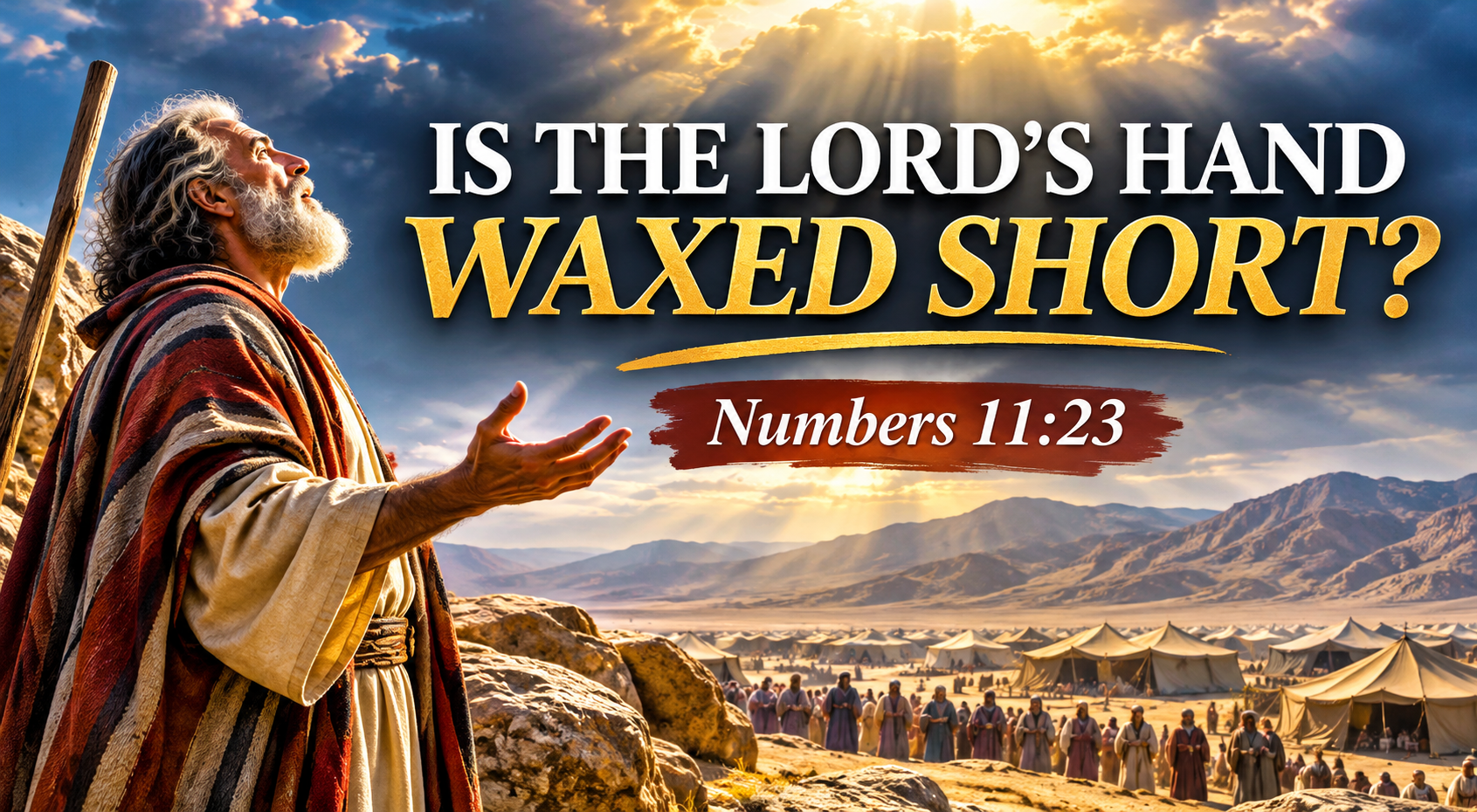
There are times in life when what God has promised seems impossible. We look at our circumstances, examine our resources, consider the obstacles before us, and wonder how God could possibly bring His Word to pass. What once seemed like a simple promise now appears to be an impossible situation.
Perhaps you have prayed for something for a long time. Maybe you are believing God for a breakthrough, a healing, provision, restoration, or an answer to a situation that seems beyond human ability. You know what God has promised in His Word, but your circumstances are telling you something entirely different. This is where Numbers 11:23 speaks so powerfully to us.
God asked Moses a question that challenged the very foundation of his thinking: "Is the LORD'S hand waxed short?" In other words, has God's ability diminished? Has His power weakened? Has the God who created the heavens and the earth somehow become incapable of doing what He has promised? Of course not! God was reminding Moses that His ability had not changed simply because the circumstances appeared impossible.
And that same truth applies to us today.
1. God's Ability Is Never Limited by Our Circumstances To understand the power of this verse, we need to look at what was happening in the wilderness. The children of Israel had been complaining about their circumstances. They were tired of eating manna and began demanding meat. They wanted something that, from a natural standpoint, appeared impossible to provide in the middle of the wilderness. Moses became overwhelmed by the situation. He questioned how he could possibly provide meat for such a multitude of people.
Numbers 11:21-22 records Moses expressing his concern about feeding the people. He essentially asked how enough animals and fish could possibly be gathered to feed such a large number of people. Moses was looking at the problem through the limitations of human ability. But God was looking at the situation through the unlimited power of His own ability.
That is an important distinction. Sometimes we make the same mistake. We look at what we have, what we lack, and what stands in our way. We calculate the cost, measure the obstacles, and determine that there simply isn't enough to accomplish what needs to be done. But God is not limited to what we have in our hands. He is not dependent upon our resources, our connections, our abilities, or our understanding. What is impossible with man is never beyond the ability of God. Jeremiah 32:17 (KJV) declares: "Ah Lord GOD! behold, thou hast made the heaven and the earth by thy great power and stretched out arm, and there is nothing too hard for thee." If God created the heavens and the earth, surely He is capable of handling the circumstances you are facing today.
2. Never Allow What You See to Determine What You Believe One of the greatest challenges of walking by faith is learning not to allow our circumstances to become greater in our thinking than the promises of God. Moses saw a wilderness. God saw an opportunity to demonstrate His power. Moses saw a shortage of resources. God saw no shortage at all. Moses saw a problem that he couldn't solve. God saw a situation that He could easily handle. This is where faith must become more than something we talk about. Faith must become the foundation upon which we stand when our circumstances challenge what we believe. Second Corinthians 5:7 (KJV) tells us: "For we walk by faith, not by sight." Walking by faith does not mean pretending that problems don't exist. It means refusing to allow those problems to determine the outcome when we have a promise from God's Word. There will be times when your natural understanding cannot explain what God is doing. There will be moments when you cannot see how the answer will come or when the breakthrough will happen. But faith doesn't require you to understand everything God is doing. It requires you to trust the One who knows the beginning from the end. Remember, your circumstances may change, your resources may become limited, and people may disappoint you, but God's power has not diminished.
3. God's Word Has Not Lost Its Power Notice the second part of God's statement to Moses: "Thou shalt see now whether my word shall come to pass unto thee or not." God wasn't simply telling Moses that He had the ability to provide meat. He was declaring that what He had spoken would come to pass. There is a tremendous difference between human promises and the Word of God. People can make promises they cannot keep. Circumstances can change. Opportunities can disappear. But God is faithful to His Word. Isaiah 55:11 (KJV) declares: "So shall my word be that goeth forth out of my mouth: it shall not return unto me void, but it shall accomplish that which I please, and it shall prosper in the thing whereto I sent it." God's Word carries the authority and power of the One who spoke it. However, we must understand something important: faith is not believing that God must do whatever we personally desire. Biblical faith is trusting His character, believing His revealed promises, and remaining obedient to His will. When God has spoken, we have every reason to trust Him. The question is not whether God has the ability to fulfill His Word. The question is whether we will continue trusting Him when we cannot yet see the fulfillment.
4. Don't Put God's Ability in a Box Sometimes we unintentionally limit God by assuming He can only work in ways we understand. We become so familiar with how things normally happen that we struggle to believe God can do something extraordinary. But throughout Scripture, God repeatedly demonstrated that He was not confined to human methods. He parted the Red Sea. He brought water from a rock. He caused the walls of Jericho to fall. He delivered David from Goliath. He shut the mouths of lions for Daniel. And in Numbers 11, He provided an abundance of quail for the children of Israel. Numbers 11:31 tells us that the Lord brought quail from the sea, and they fell around the camp. What appeared impossible to Moses became a demonstration of God's power. We must be careful not to put limitations on how God can work. He can open doors that no person can open. He can provide when resources are scarce. He can bring restoration where people have given up hope. We should never confuse our inability with God's inability. Just because you cannot see a way does not mean God cannot make one.
5. The God Who Worked Then Is Still God Today It is easy to read the miracles of the Bible and think about how wonderful it would have been to witness those events firsthand. But we must remember that the God who performed those miracles has not changed. Malachi 3:6 (KJV) declares: "For I am the LORD, I change not..." God's character has not changed. His faithfulness has not changed. His power has not changed. We must never develop a theology that makes God powerful in the past but powerless in the present. The same God who delivered Israel is still able to deliver. The same God who provided in the wilderness is still able to provide. The same God who demonstrated His power throughout Scripture is still able to work in the lives of those who trust Him. This doesn't mean every situation will unfold exactly as we expect. It means we can confidently trust God's character, His wisdom, His promises, and His faithfulness regardless of what we face. Hebrews 13:8 (KJV) reminds us: "Jesus Christ the same yesterday, and to day, and for ever." Our confidence is not in our circumstances. Our confidence is in the unchanging God.
Everyday Application
- 1. Stop Measuring Your Problems by Your Own Ability.
- When you face something that seems impossible, remember that your resources are not the measure of God's ability. Instead of focusing exclusively on what you lack, begin by seeking God, standing on His Word, and trusting His direction.
- 2. Refuse to Let Fear Overrule Your Faith.
- Fear will constantly remind you of everything that could go wrong. Faith reminds you of who God is. When circumstances become overwhelming, return to Scripture and allow God's promises to renew your thinking.
- 3. Expect God to Be Faithful, Even When You Cannot See the Answer.
- Don't confuse waiting with abandonment. Continue praying, obeying, and trusting God. Your responsibility is to remain faithful while leaving the outcome in His hands.
Closing Encouragement
I want to encourage you to stop looking at your circumstances as though they have the final word. God has the final word! Whatever you are facing today, remember this: Your situation may be impossible for you, but it is never beyond the ability of God. Keep believing, praying and most of all KEEP Trusting God!!!
Reader Comments
Please be kind, stay on topic, and protect other people's privacy. No harassment, advertising, or spam. Comments are reviewed before appearing. Community guidelines
No comments yet.
Related Teachings
FAITH IN ACTION - DAVID - BOOK 10
Discover the inspiring story of David, the shepherd who became king and was known as a man after God's own heart. Explore powerful biblical lessons about faith, courage, obedience, patience, leadership, repentance, and trusting God's timing. Learn how David's life reminds us that God looks beyond outward appearances and desires a heart that is willing to follow Him.
FAITH IN ACTION - ESTHER - BOOK 9
Discover the inspiring story of Esther and how she found the courage to stand up for her people. Her journey teaches powerful lessons about faith, God's providence, courage, wisdom, and recognizing the opportunities God places before us. Learn what it means to answer God's call for such a time as this.