Understanding Scripture
HOW TO READ THE BIBLE
By David Boiarsky · November 3, 2026
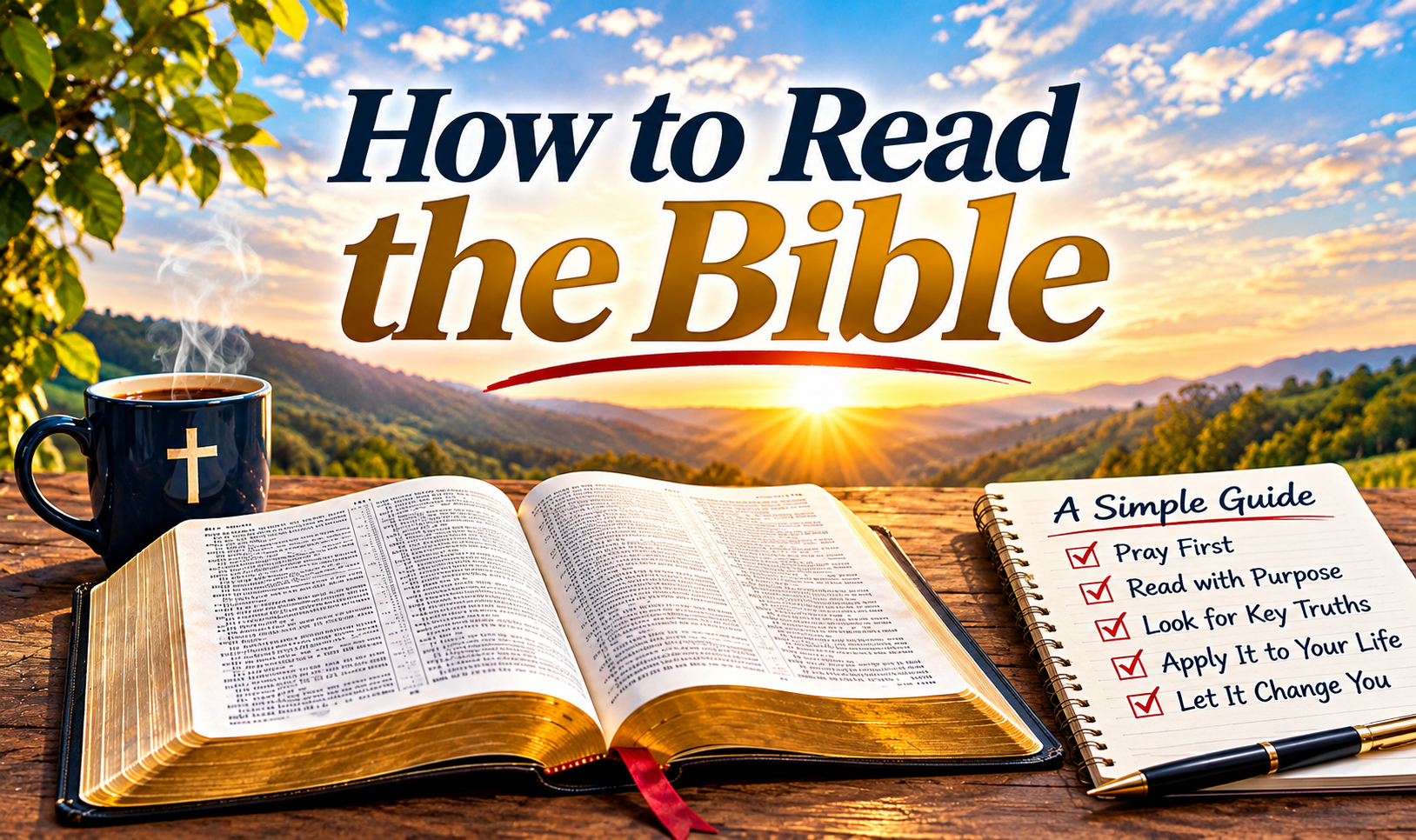
How to Read the Bible: Discovering God's Word for Your Life
Your Bible is more than a book to be read. It is God's written Word, given to reveal His character, His purposes, His promises, and His plan for humanity. Through Scripture, we discover who God is, what He has done through Jesus Christ, and how He desires us to live.
Perhaps you are new to Christianity and wondering where to begin reading the Bible. Maybe you've owned a Bible for years but sometimes struggle to understand what you are reading. You may open its pages, read a chapter, and close it without knowing how to apply what you've just read.
Wherever you find yourself today, understand this: You don't have to be a Bible scholar to begin discovering the richness of God's Word. You simply need a willing heart, a desire to learn, and a commitment to allow Scripture to speak into your life.
The Bible was never intended to be a book that sits on a shelf or is opened only when problems arise. It is meant to become an essential part of our daily walk with God.
Reading the Bible is not about how many chapters you can finish in a day, how quickly you can read through the entire Bible, or how many verses you can memorize. It is about understanding what God has revealed and allowing His truth to shape the way you think, believe, and live.
You don't have to understand everything the first time you read it. There will be passages that challenge you, questions that require further study, and truths that become clearer as you grow in your understanding.
The important thing is to begin.
God wants you to know His Word, understand His truth, and develop a life that is grounded in biblical principles.
The more you become familiar with Scripture, the better equipped you will be to recognize truth, resist deception, strengthen your faith, and make decisions that honor God.
The goal is not simply to read the Bible from beginning to end. It is to understand what you read and allow God's Word to become the foundation of your life.
Thy word is a lamp unto my feet, and a light unto my path. — Psalm 119:105 (KJV)
Notice that the Psalmist describes God's Word as a lamp and a light. He understood that Scripture provides direction for the journey of life.
The Bible gives us wisdom when we face difficult decisions, encouragement when we become discouraged, correction when we need it, and promises to strengthen our faith.
But we must do more than simply read its words. We must learn how to understand what we are reading.
There is a difference between reading a passage and understanding its meaning. We can read several chapters without remembering what we read. We can become familiar with a Scripture without understanding its original message or how it applies to our lives.
Learning to read the Bible effectively requires us to slow down, pay attention, ask questions, and allow Scripture to interpret Scripture.
Here are six practical principles that can help you develop a meaningful and consistent Bible-reading habit.
1. Begin with the Right Place
All scripture is given by inspiration of God, and is profitable for doctrine, for reproof, for correction, for instruction in righteousness: — 2 Timothy 3:16 (KJV)
One of the most common questions people ask is, "Where should I begin reading the Bible?"
The Bible contains 66 books, written over many centuries, with different literary styles, historical settings, and purposes. Trying to read everything at once can become overwhelming, especially for someone who is just beginning.
You don't necessarily have to begin with Genesis and read straight through to Revelation.
A good starting point is one of the four Gospels: Matthew, Mark, Luke, or John.
The Gospels introduce us to Jesus Christ. They reveal His teachings, His miracles, His compassion, His authority, His death, and His resurrection.
John is an especially helpful place to begin because it emphasizes who Jesus is and why He came.
After reading one of the Gospels, consider continuing with Acts to discover how the early Church began and how the Holy Spirit worked through the believers.
You can then move into the New Testament letters to learn about salvation, faith, grace, obedience, spiritual growth, and Christian living.
The Old Testament is equally important. It reveals God's dealings with humanity, His covenant promises, His faithfulness, and the history leading to the coming of Jesus Christ.
Remember, the entire Bible is important. The key is developing a reading plan that helps you understand what you are reading.
Don't allow the size of the Bible to intimidate you. Begin somewhere, establish a consistent routine, and keep going.
2. Read for Understanding, Not Just Completion
So then faith cometh by hearing, and hearing by the word of God. — Romans 10:17 (KJV)
One of the biggest mistakes people make when reading the Bible is becoming more concerned about finishing a chapter than understanding its message.
You can read five chapters in a day and remember very little. On the other hand, you can spend twenty minutes studying one passage and discover a truth that changes how you approach your entire day.
The purpose of reading Scripture is not to accomplish a religious assignment. It is to understand what God has revealed through His Word.
Slow down and give the passage your attention.
As you read, ask yourself:
- What is this passage saying? - Who is speaking, and to whom? - What is happening in this passage? - What does this teach me about God? - Is there a command, promise, warning, or principle I need to understand? - How does this truth apply to my life?
These questions help move you beyond simply reading words on a page.
For example, when you read Philippians 4:13, "I can do all things through Christ which strengtheneth me," consider the surrounding verses. Paul is discussing learning contentment in different circumstances.
Understanding the context helps us recognize the truth Paul is communicating rather than simply taking one verse and applying it without considering its meaning.
Don't be afraid to read a passage more than once. Sometimes the second or third reading reveals something you missed the first time.
Remember, understanding Scripture is more important than the number of pages you complete.
3. Learn to Read Scripture in Its Proper Context
Study to shew thyself approved unto God, a workman that needeth not to be ashamed, rightly dividing the word of truth. — 2 Timothy 2:15 (KJV)
This is one of the most important principles of Bible study.
A Scripture taken out of context can be misunderstood or misapplied.
Every passage has a setting, an audience, and a message. Understanding those things helps us recognize what the passage actually teaches.
When reading a particular verse, take time to read the verses before and after it. Sometimes it is helpful to read the entire chapter to understand the complete thought.
Consider these questions:
- Who wrote this book? - Who was the original audience? - What was happening historically? - What was the writer communicating? - How does this passage fit with the rest of Scripture?
For example, the book of James emphasizes the relationship between genuine faith and our actions. When we read James 2, we discover that James is addressing a faith that is merely professed but produces no corresponding evidence in a person's life.
Understanding the context protects us from building beliefs around isolated statements.
It is also important to recognize the different types of writing found in the Bible.
Historical books tell us about events and people. Psalms contain worship, prayers, and expressions of faith. Proverbs provide wisdom and practical instruction. The Gospels record the life and ministry of Jesus. The Epistles teach believers how to understand and live out their faith.
Each type of writing should be approached with an understanding of its purpose.
Don't assume that every passage is written in the same style or should be interpreted in exactly the same way.
The more you understand the context of Scripture, the better equipped you will be to understand its message accurately.
4. Allow Scripture to Interpret Scripture
For precept must be upon precept, precept upon precept; line upon line, line upon line; here a little, and there a little: — Isaiah 28:10 (KJV)
The Bible is not a collection of unrelated religious sayings. Its message unfolds throughout Scripture, revealing God's purposes and His plan of redemption through Jesus Christ.
One of the best ways to understand a difficult passage is to compare it with other passages that address the same subject.
For example, if you are studying faith, don't limit your study to one verse. Look at what Jesus taught about faith, what Paul wrote about faith, and how faith operated in the lives of people throughout Scripture.
If you are studying prayer, examine the prayers of David, the teachings of Jesus, and the instructions given to the early Church.
As you compare Scripture with Scripture, you begin to see how biblical truths connect.
This is especially important when studying subjects such as salvation, grace, healing, the Holy Spirit, spiritual gifts, faith, and the Kingdom of God.
A single verse should never be used to contradict the clear teaching of the rest of the Bible.
Cross-referencing helps us develop a more complete understanding of biblical truth.
There are several resources that can help:
- A good Bible concordance can help you locate Scriptures dealing with a particular subject. - A Bible dictionary can explain biblical words, places, people, and customs. - A study Bible can provide historical background and helpful explanations. - A reliable Bible commentary can offer additional insight into difficult passages.
These resources can be valuable, but remember that they are tools to help you study. They are not a substitute for Scripture itself.
Always examine what you read in light of God's Word.
The more familiar you become with the Bible as a whole, the better equipped you will be to recognize how individual passages fit into its overall message.
5. Depend on the Holy Spirit to Help You Understand God's Word
Howbeit when he, the Spirit of truth, is come, he will guide you into all truth: — John 16:13 (KJV)
Reading the Bible is not simply an intellectual exercise. We need the help of the Holy Spirit as we seek to understand and apply God's Word.
The Holy Spirit inspired the Scriptures and works in the lives of believers to help us understand spiritual truth.
First Corinthians 2:12 reminds us that believers have received the Spirit of God so that we might know the things that are freely given to us by God.
This doesn't mean we should expect the Holy Spirit to replace careful reading, study, or sound interpretation.
Rather, we should approach Scripture prayerfully, asking Him to help us recognize truth, understand what we are reading, and respond in obedience.
Before reading, take a moment to pray.
Ask God to give you understanding. Ask Him to reveal areas where your thinking needs to change. Ask for wisdom to recognize how the passage applies to your life.
When something is difficult to understand, don't immediately assume that your first impression is correct. Study the passage, examine its context, and compare it with other Scriptures.
The Holy Spirit will never lead us into an understanding that contradicts the truth of God's written Word.
We should also recognize that understanding Scripture involves both knowledge and spiritual maturity.
It is possible to know many Bible verses and still struggle to demonstrate love, patience, forgiveness, and humility.
God wants His Word to become more than information stored in our minds. He wants it to produce transformation in our lives.
As you read, depend upon the Holy Spirit to help you grow in both understanding and obedience.
6. Put What You Read Into Practice
But be ye doers of the word, and not hearers only, deceiving your own selves. — James 1:22 (KJV)
Here is where Bible reading becomes a life-changing experience.
It is possible to read the Bible every day, attend church regularly, and become familiar with hundreds of Scriptures without allowing those truths to influence our decisions and behavior.
James reminds us that hearing the Word without responding to it can deceive us.
God's Word was never intended merely to increase our biblical knowledge. It is meant to direct our lives.
If Scripture teaches us to forgive, we must be willing to forgive.
If it teaches us to walk in love, our words and actions should reflect that love.
If it teaches us to trust God, we must learn to trust Him when circumstances challenge our faith.
If it teaches us to be generous, we should look for opportunities to help others.
If it teaches us to resist temptation, we must be willing to make decisions that protect our spiritual lives.
This is why it is important to ask yourself one final question after reading a passage:
What am I going to do with what I have just read?
You may discover something that needs to change in your attitude. You may recognize a promise you need to stand upon. You may receive encouragement to persevere through a difficult situation.
Whatever the application, take time to respond.
You don't have to change everything in one day. Begin by putting one biblical truth into practice.
Remember, the purpose of reading God's Word is not simply to know what it says. It is to allow what it says to influence how you live.
A believer who consistently reads, studies, understands, and applies Scripture develops a foundation that can withstand the challenges of life.
A Simple Daily Bible-Reading Routine
Developing a consistent habit doesn't have to be complicated.
Here is a simple approach you can begin using today:
1. Begin with prayer. Ask the Holy Spirit to help you understand God's Word. 2. Read a manageable passage. Start with a chapter or a smaller section. 3. Read it carefully. Don't rush. Read it more than once if necessary. 4. Look at the context. Understand who is speaking, what is happening, and what is being communicated. 5. Write down what you learn. Record an important truth, promise, instruction, or question. 6. Identify a practical application. Determine how you can put what you have read into practice. 7. End with prayer. Thank God for His Word and ask Him to help you live according to its truth.
You might spend fifteen or twenty minutes doing this each day.
As you become more comfortable studying Scripture, you can gradually increase the time you spend reading and studying.
Don't become discouraged if you miss a day. Simply return to your Bible and continue.
Consistency is more important than trying to accomplish too much at once.
Remember, you are developing a lifelong relationship with God's Word, not completing a temporary assignment.
A Prayer for Understanding God's Word
Heavenly Father,
Thank You for giving us Your Word. Thank You that through Scripture I can discover Your character, understand Your promises, and learn how You desire me to live.
Give me a hunger for Your Word. Help me develop the discipline to read it consistently and the desire to understand its truth.
Holy Spirit, guide me as I study. Help me recognize what Scripture is teaching, understand its meaning, and see how it applies to my everyday life.
When I encounter passages I don't understand, give me patience to study and the wisdom to seek the truth. Protect me from misunderstanding Your Word or allowing my own opinions to influence what it says.
Help me become more than a hearer of the Word. Give me the courage to obey what You teach me and the faith to stand upon Your promises.
Let Your Word shape my thoughts, influence my decisions, strengthen my faith, and transform my character.
I don't want to simply read the Bible. I want to know Your truth, understand Your heart, and live according to Your Word.
In Jesus' name, Amen.
Everyday Application
- Reading the Bible becomes meaningful when we begin putting its truth into practice.
- Take a few moments to consider these questions:
- 1. Am I reading the Bible consistently, or do I only open it when I need something?
- 2. Am I taking time to understand what I read, or am I simply trying to finish a certain number of chapters?
- 3. Do I consider the context of Scripture before deciding what a passage means?
- 4. Am I comparing Scripture with Scripture when studying difficult subjects?
- 5. Am I depending on the Holy Spirit to help me understand and apply God's Word?
- 6. Is there something I have recently read in Scripture that I need to put into practice?
- Don't try to accomplish everything at once. Start with a manageable reading plan, develop a consistent routine, and allow God's Word to become part of your everyday life.
Closing Encouragement
You don't have to be a Bible scholar to understand God's Word, and you don't have to understand everything the first time you read it. Begin where you are. Open your Bible with a willing heart. Take time to read carefully, study the context, compare Scripture with Scripture, and ask the Holy Spirit to help you understand what you are reading. Don't allow unfamiliar passages or difficult questions to discourage you. Keep studying. Keep asking questions. Keep growing in your understanding. Most importantly, don't allow Bible reading to become nothing more than a daily religious routine. God's Word is meant to influence your thinking, strengthen your faith, direct your decisions, and shape your character. The Bible is not simply a book to be read. It is God's truth to be understood, believed, and lived. The more you understand God's Word, the better equipped you will be to recognize truth, stand firm in your faith, and live the life God has called you to live. Open your Bible. Read it. Study it. Believe it. Live it. There is always more to discover in God's Word!
Reader Comments
Please be kind, stay on topic, and protect other people's privacy. No harassment, advertising, or spam. Comments are reviewed before appearing. Community guidelines
No comments yet.
Related Teachings
FAITH IN ACTION - DAVID - BOOK 10
Discover the inspiring story of David, the shepherd who became king and was known as a man after God's own heart. Explore powerful biblical lessons about faith, courage, obedience, patience, leadership, repentance, and trusting God's timing. Learn how David's life reminds us that God looks beyond outward appearances and desires a heart that is willing to follow Him.
FAITH IN ACTION - ESTHER - BOOK 9
Discover the inspiring story of Esther and how she found the courage to stand up for her people. Her journey teaches powerful lessons about faith, God's providence, courage, wisdom, and recognizing the opportunities God places before us. Learn what it means to answer God's call for such a time as this.