Biblical Teaching
FAITH IN ACTION - MOSES - BOOK 3
By David Boiarsky · November 5, 2026
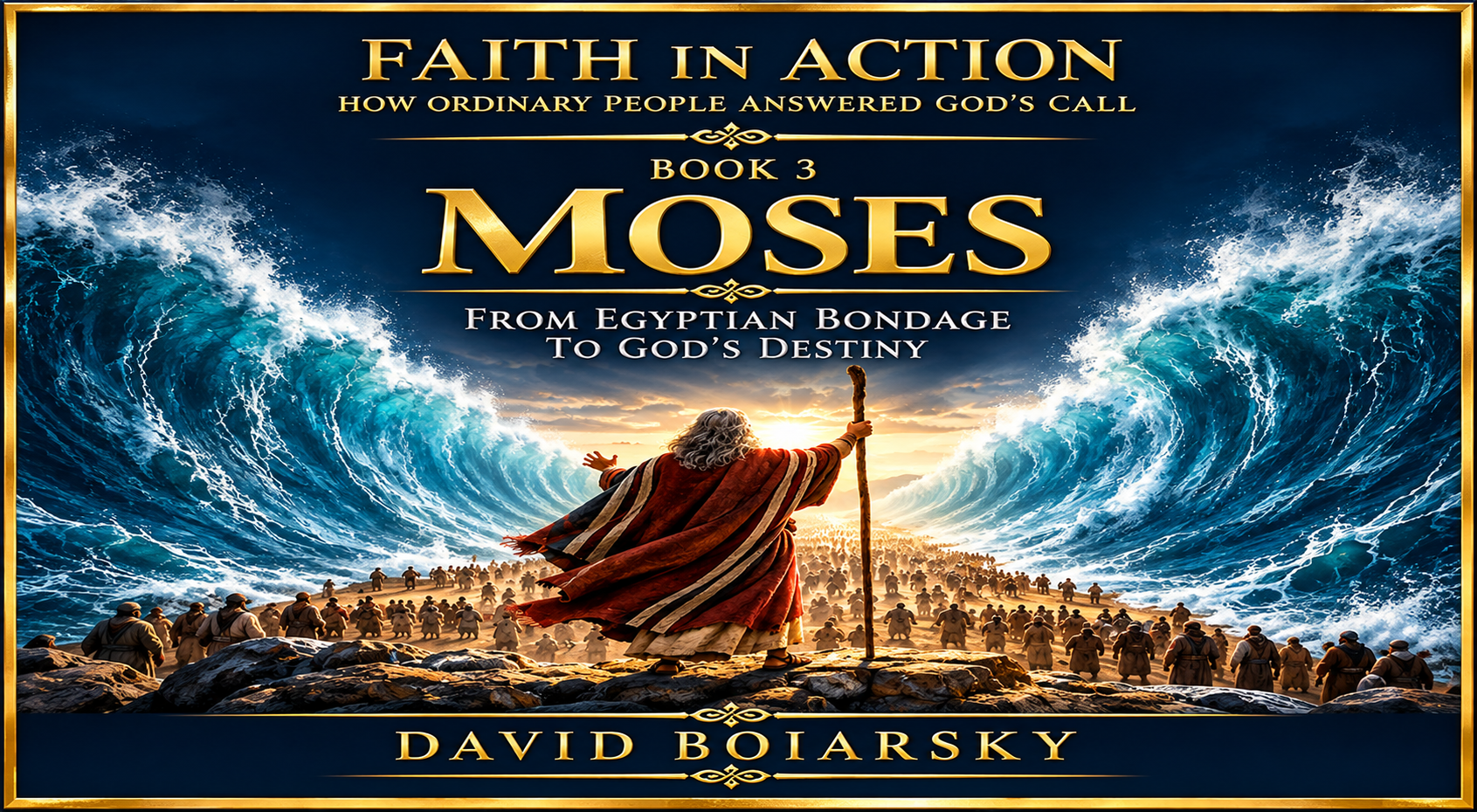
Moses: When God Calls You Beyond Your Ability
Learning to Trust God When You Feel Inadequate
Have you ever faced a responsibility that seemed much bigger than your abilities? Perhaps you felt unqualified, lacked experience, or wondered whether you had what it would take to succeed. You looked at the situation and immediately began thinking about all the reasons you could not do it.
If you have ever felt that way, you are in good company.
Moses understood what it meant to feel inadequate. When God called him to lead the children of Israel out of Egyptian bondage, Moses did not respond with confidence. He questioned his ability, worried about how others would receive him, and repeatedly offered reasons why someone else might be better suited for the assignment.
Yet Moses' story reminds us of an important truth: **God's purposes are not dependent upon human perfection, and our limitations do not have to become an excuse for refusing to grow or serve faithfully.**
The question is not always, "Am I capable of doing this by myself?" Sometimes the better question is, "What is the right thing to do, and how can I faithfully respond with the abilities and resources God has provided?"
An Ordinary Day and an Extraordinary Encounter
Moses' life had taken an unexpected turn long before he encountered the burning bush.
As a young child, he was rescued from the Nile River and raised in Pharaoh's household. Acts 7:22 tells us that Moses was learned in all the wisdom of the Egyptians and was mighty in words and deeds.
But his life changed dramatically after he killed an Egyptian who was mistreating a Hebrew man. When Pharaoh learned what had happened and sought to kill Moses, he fled to the land of Midian.
There he married Zipporah, became part of her family, and began working as a shepherd.
Years passed. Moses was no longer living in the palace. He was no longer surrounded by the privileges of Egypt. He was tending sheep in the wilderness.
Then something extraordinary happened.
Exodus 3:2 tells us:
"And the angel of the LORD appeared unto him in a flame of fire out of the midst of a bush: and he looked, and, behold, the bush burned with fire, and the bush was not consumed." — Exodus 3:2, KJV
Moses turned aside to investigate. God called to him from the bush and instructed him to remove his shoes because the ground where he stood was holy.
Think about where Moses was when God met him. He was not standing before Pharaoh, leading an army, or speaking to a multitude. He was faithfully carrying out an ordinary responsibility.
There is an important lesson here. We should never underestimate the value of being faithful in the season we are presently living.
Sometimes we spend so much time thinking about what we might do someday that we overlook the opportunities to serve faithfully today. Your present circumstances may not look extraordinary, but that does not mean they are unimportant.
Moses' burning bush encounter was a unique event in biblical history. We should not assume that every unusual experience or coincidence is a special message from God. Our decisions must be grounded in Scripture, prayer, sound judgment, and wise counsel.
The important principle is that Moses was available in the middle of his ordinary responsibilities when God gave him a specific assignment.
God Sees What Others May Overlook
When God spoke to Moses, He explained that He had seen the suffering of His people in Egypt.
Exodus 3:7 says:
"And the LORD said, I have surely seen the affliction of my people which are in Egypt, and have heard their cry by reason of their taskmasters; for I know their sorrows." — Exodus 3:7, KJV
God had not forgotten Israel.
He had seen their suffering, heard their cries, and knew their sorrow. He then declared His intention to deliver them from Egyptian bondage and bring them into the land He had promised.
Notice that God's assignment for Moses was connected to something much bigger than Moses himself.
He was not being called to build his own reputation or establish his own importance. He was being sent to serve God's purpose and help bring deliverance to an oppressed people.
That is an important principle for Christian service today.
We should not evaluate every opportunity by how much recognition it will bring or how important it will make us appear. We should consider whether it is consistent with Scripture, whether it genuinely serves others, and whether we can undertake it with integrity.
Godly service is not about making ourselves important. It is about faithfully serving the Lord and the people He places before us.
"Who Am I?" — When Inadequacy Speaks
When God told Moses to go to Pharaoh and bring the Israelites out of Egypt, Moses responded with a question.
Exodus 3:11 says:
"And Moses said unto God, Who am I, that I should go unto Pharaoh, and that I should bring forth the children of Israel out of Egypt?" — Exodus 3:11, KJV
"Who am I?"
Those words reveal the struggle of a man who could see the size of the assignment but had difficulty seeing himself fulfilling it.
Moses looked at his limitations. He understood the difficulty of confronting Pharaoh and leading an entire nation. He knew this was no small responsibility.
Perhaps he remembered his earlier failure in Egypt. Perhaps he wondered whether the Israelites would accept him. Whatever his private thoughts may have been, his question reveals that he did not feel qualified.
But look at God's response.
Exodus 3:12 says:
"And he said, Certainly I will be with thee..." — Exodus 3:12, KJV
God did not tell Moses that he possessed every ability necessary to accomplish the assignment independently. He promised His presence.
That was the foundation Moses needed to understand.
There is a difference between self-confidence and confidence in God. Self-confidence says, "I can handle this because I am capable." Biblical faith recognizes our limitations while trusting the character, wisdom, and faithfulness of God.
Paul expressed this truth in 2 Corinthians 3:5:
"Not that we are sufficient of ourselves to think any thing as of ourselves; but our sufficiency is of God."
We do not have to pretend we are capable of everything. We can acknowledge our weaknesses, develop our abilities, seek help, and still move forward responsibly.
Do not allow the question "Who am I?" to become a reason for never attempting anything meaningful.
When You Have More Questions Than Answers
Moses continued asking questions.
He wanted to know what he should say if the Israelites asked which God had sent him. God answered by revealing His name and explaining the message Moses was to deliver.
The Lord also told him what would happen when he approached Pharaoh. Moses was not left entirely without direction. God gave him information about the assignment and warned him that Pharaoh would initially resist.
There is something important we should understand about faith.
Having questions does not automatically mean we lack faith. We all encounter situations that require information, wisdom, and careful consideration.
The problem is not asking questions. The problem comes when we refuse to accept reasonable answers or continually search for another reason to avoid responsibility.
Sometimes we want God to guarantee that a decision will involve no opposition, no disappointment, and no unexpected challenges. But Scripture does not promise that every act of obedience will be easy.
God told Moses that Pharaoh would resist. That warning did not mean Moses should abandon the assignment. It helped prepare him for what lay ahead.
We should not assume that every obstacle means we have misunderstood God's direction. Neither should we assume that every obstacle proves we are on the right path.
We need discernment.
We must examine our decisions in light of Scripture, seek wise counsel, and remain willing to make corrections when necessary.
Faith does not require us to know everything about tomorrow. It calls us to trust God while faithfully responding to what we understand today.
The Fear of Rejection
Moses had another concern.
He wondered whether the Israelites would believe him or listen to what he had to say.
Exodus 4:1 records his words:
"And Moses answered and said, But, behold, they will not believe me, nor hearken unto my voice..." — Exodus 4:1, KJV
Moses was concerned about how people would respond.
That is something many of us understand. We may hesitate to speak the truth because someone might disagree. We may avoid accepting responsibility because we are afraid of criticism. We may remain silent when we should speak because we do not want to be rejected.
God responded to Moses by giving him specific signs that confirmed his commission. These signs belonged to Moses' unique assignment and should not be treated as a requirement that every believer must reproduce today.
There is still a valuable lesson in this account.
We cannot control every person's response to what we say or do. Even when we act with integrity and communicate truthfully, some people will disagree with us.
Our responsibility is not to guarantee universal approval. It is to be faithful, truthful, and respectful.
At the same time, we must remain teachable. Not every criticism is persecution, and not every disagreement means we are right.
Courage and humility belong together.
A faithful Christian should be willing to stand for biblical truth while remaining willing to listen, learn, and correct mistakes.
When You Think You Cannot Speak
Moses raised another objection.
Exodus 4:10 says:
"And Moses said unto the LORD, O my Lord, I am not eloquent, neither heretofore, nor since thou hast spoken unto thy servant: but I am slow of speech, and of a slow tongue." — Exodus 4:10, KJV
Moses believed his speaking ability was a serious limitation. The assignment required him to communicate with the elders of Israel and confront Pharaoh, yet he did not believe he was capable of doing it effectively.
God reminded Moses that He was the Creator of the human mouth and that He would help him communicate.
Exodus 4:12 says:
"Now therefore go, and I will be with thy mouth, and teach thee what thou shalt say." — Exodus 4:12, KJV
God also provided Aaron to serve as Moses' spokesman.
This is an important part of the story. Moses was not expected to accomplish everything entirely by himself.
There is nothing wrong with recognizing that we need help. In fact, asking for assistance can be an expression of humility and wisdom.
Some people are natural speakers. Others communicate better through writing or one-on-one conversations. Some need additional training before accepting certain responsibilities.
We should not pretend that everyone has the same abilities.
But we should not assume that a limitation automatically prevents us from making a meaningful contribution.
Preparation is not a lack of faith. If you are asked to teach, study. If you are asked to lead, prepare. If you need to develop a particular ability, be willing to learn.
God can work through people who recognize their limitations and are willing to grow.
The Danger of Making Excuses
After God answered Moses' concerns, Moses made another request.
Exodus 4:13 says:
"And he said, O my Lord, send, I pray thee, by the hand of him whom thou wilt send." — Exodus 4:13, KJV
Moses was asking God to send someone else.
There is a difference between asking honest questions and continually making excuses.
Questions can help us understand a responsibility. They can reveal information we lack, abilities we need to develop, or risks we need to consider.
Excuses, however, can become a way of avoiding responsibility even after reasonable concerns have been addressed.
We may tell ourselves that we need more time, more confidence, more experience, or better circumstances. Sometimes those things are genuinely necessary. But sometimes we use them to postpone something we already know we should address.
Moses' story does not hide his hesitation. He questioned, objected, and resisted. Yet God continued to work with him and provided Aaron to assist him.
That does not mean God approved of every objection Moses raised. It does remind us that our struggles do not have to become our permanent identity.
We can acknowledge our fears, receive correction, seek help, and learn to respond more faithfully.
Do not wait until you feel completely confident before you begin doing what is right. Appropriate preparation and courageous action can work together.
Obedience Must Become Action
After the encounter at the burning bush, Moses began moving toward Egypt.
He spoke with Jethro, his father-in-law, and asked permission to return to his brethren. He then took his wife and sons and set out on the journey.
Exodus 4:20 says:
"And Moses took his wife and his sons, and set them upon an ass, and he returned to the land of Egypt: and Moses took the rod of God in his hand." — Exodus 4:20, KJV
Notice the change.
Earlier, Moses had questioned his suitability for the assignment and asked God to send someone else. Now he was moving.
The Bible does not tell us that Moses suddenly became free from every fear. It shows us that he began acting on the direction he had received.
Obedience does not require us to feel fearless. It requires us to respond faithfully.
Many people have good intentions. They intend to spend more time studying Scripture, help someone who is struggling, correct a bad habit, or become more faithful in their responsibilities.
But intentions do not automatically become actions.
There comes a time when preparation must become movement.
That does not mean we should rush into decisions without considering the consequences. Faith and responsibility belong together. Our choices affect other people, and we should not use a claimed calling as an excuse to neglect legitimate family or personal responsibilities.
We should pray, seek wisdom, communicate honestly, and consider the practical demands of our decisions.
When the next appropriate step becomes clear, be willing to take it.
When Obedience Meets Opposition
Moses and Aaron eventually went before Pharaoh with God's message.
Exodus 5:1 says:
"And afterward Moses and Aaron went in, and told Pharaoh, Thus saith the LORD God of Israel, Let my people go..." — Exodus 5:1, KJV
Pharaoh refused.
Instead of releasing the Israelites, he increased their burdens. He commanded them to produce the same number of bricks without receiving the straw previously supplied to them.
The people suffered, and their situation became more difficult.
Think about what Moses must have faced at that moment. He had obeyed God's instruction, but the immediate result was not what he might have expected.
Instead of seeing the people released, he encountered greater opposition.
Moses returned to the Lord with a difficult question.
Exodus 5:22 says:
"And Moses returned unto the LORD, and said, Lord, wherefore hast thou so evil entreated this people? why is it that thou hast sent me?" — Exodus 5:22, KJV
Moses was struggling to understand what had happened.
He had obeyed, but the situation appeared to have become worse.
Notice that he brought his concern to God. He did not pretend everything was going well.
Faith does not require us to hide our disappointment from the Lord. We can pray honestly about our confusion, frustration, and pain.
But we must be careful not to judge an entire story by one difficult chapter.
Exodus 5 was not the end of Israel's deliverance. God reaffirmed His covenant and His intention to bring His people out of Egypt.
Sometimes doing what is right does not produce immediate relief. Speaking truth can bring resistance. Correcting a harmful situation can create tension before improvement becomes possible.
When that happens, we need wisdom. Sometimes we must persevere. Sometimes we need to adjust our approach. Sometimes we must acknowledge that we have made a mistake.
A disappointing result does not automatically mean that faithfulness has failed.
The God Who Delivers His People
Moses' journey did not end with his first confrontation with Pharaoh.
God continued working through the events recorded in Exodus. The plagues came upon Egypt, Pharaoh eventually released the Israelites, and God led His people out of bondage.
Then came another crisis.
Pharaoh pursued the Israelites, and they found themselves facing the Red Sea. The people became afraid because they could see the Egyptian army behind them and the sea in front of them.
Moses responded with words of encouragement.
Exodus 14:13 says:
"And Moses said unto the people, Fear ye not, stand still, and see the salvation of the LORD, which he will shew to you to day..." — Exodus 14:13, KJV
God instructed Moses to stretch out his rod over the sea. The Lord divided the waters, and the Israelites crossed on dry ground.
This was a decisive moment in Israel's deliverance.
The man who had once asked, "Who am I?" had become the leader through whom God brought His people out of Egypt.
But we must understand something important about this account.
Moses was God's servant, not the source of Israel's deliverance. The power belonged to the Lord. Moses obeyed, but God was the One who delivered His people.
The central message of Exodus is not that Moses discovered his own greatness. It is that God remained faithful to His covenant and acted to deliver Israel.
That distinction matters in our Christian lives as well.
We should develop our abilities and take our responsibilities seriously, but we must never confuse our usefulness with being the source of God's power.
We are servants, not saviors. Jesus Christ alone is the Savior of the world.
The Journey Was Not Easy
Although God delivered Israel from Egypt, the wilderness journey was difficult.
The people complained. They struggled with fear and unbelief. Moses faced criticism and heavy leadership responsibilities.
His story reminds us that accepting a responsibility does not mean every subsequent day will be easy.
Some responsibilities require endurance. Some involve repeated challenges. Some reveal weaknesses we did not recognize at the beginning.
We must learn to depend upon God throughout the journey, not merely at the moment we accept a responsibility.
Moses was not a perfect leader. He needed God's direction, received help from others, faced discouragement, and made mistakes along the way.
Yet he continued to serve.
That should encourage anyone who feels inadequate.
You do not need to know everything before you begin learning. You do not need to possess every ability before you begin developing the abilities you have. You do not need to accomplish everything independently.
You need humility, a willingness to learn, and a commitment to act faithfully within the responsibilities entrusted to you.
What Moses Teaches Us About Faith and Obedience
Moses' life gives us several important lessons.
First, God knows our limitations. Moses did not surprise God by expressing his concerns. God knew his history, circumstances, and abilities. We do not have to pretend to be stronger or more capable than we are.
Second, God's presence is more important than our confidence. Moses needed to understand that the assignment was not about his ability to control every outcome. His responsibility was to trust God and carry out the instructions he had received.
Third, we must not allow excuses to become a habit. There is a difference between seeking wisdom and continually searching for a reason to avoid responsibility. We should be honest enough to recognize when caution has become avoidance.
Fourth, obedience does not guarantee an easy journey. Moses encountered resistance from Pharaoh, discouragement among the Israelites, and many challenges in the wilderness. Faithfulness is not a guarantee of comfortable circumstances.
Finally, we do not have to see the whole journey before taking the next appropriate step. Moses did not receive a complete explanation of every event that would unfold. He received direction for the work ahead.
We should study Scripture, pray, seek wise counsel, consider our responsibilities, and make sound decisions. Sometimes the wisest response is to wait for more information. At other times, the next step is already clear.
Learning to recognize the difference is part of growing in Christian maturity.
Stop Disqualifying Yourself
As we come to the end of Moses' story, think again about the question he asked at the burning bush.
"Who am I?"
Moses looked at himself and saw reasons he was not the right person for the assignment. He questioned his ability to lead, wondered whether the Israelites would believe him, and expressed concern about his speaking ability.
Yet God continued to address his concerns and provide what was needed for the responsibility ahead.
Moses' story teaches us that feeling inadequate does not necessarily mean we are unable to serve God faithfully.
Sometimes we need additional preparation. Sometimes we need assistance. Sometimes we need to reconsider an idea because it is not consistent with Scripture or our present responsibilities.
But sometimes we simply need to stop allowing fear to make our decisions.
Perhaps you have avoided something because you believe you are not qualified. Maybe you have refused an opportunity to serve because you were afraid of making a mistake. Perhaps a past failure has convinced you that your best days are behind you.
Do not allow your limitations to become the final authority over your life.
You may never lead a nation out of bondage or stand before a king. Your responsibility may be much quieter. You may be called to encourage a discouraged believer, teach a child the truth of Scripture, help a neighbor, serve your church, or faithfully fulfill a responsibility that few people notice.
Do not measure the importance of your obedience by how impressive it appears to other people.
Be faithful where you are. Develop the abilities you have. Seek wisdom when you need it. Remain humble enough to receive correction.
And when the next appropriate step becomes clear, be willing to take it.
Moses began his journey with a question about his own ability, but the story did not end at the burning bush.
He went to Egypt. He confronted Pharaoh. He witnessed God's mighty acts of deliverance. He led the Israelites through the Red Sea and continued serving God through the challenges of the wilderness.
Moses was not perfect, but God used him to accomplish an extraordinary purpose.
When you feel inadequate, remember the difference between depending on yourself and depending on God. You do not have to know everything, possess every ability, or control every outcome.
Closing Encouragement
You do need to remain faithful to God's Word, use the abilities and opportunities you have been given, and keep your eyes on Jesus Christ. Do not let the question "Who am I?" become the end of your story. Let it remind you to depend more fully upon the God you serve.
Reader Comments
Please be kind, stay on topic, and protect other people's privacy. No harassment, advertising, or spam. Comments are reviewed before appearing. Community guidelines
No comments yet.
Related Teachings
FAITH IN ACTION - DAVID - BOOK 10
Discover the inspiring story of David, the shepherd who became king and was known as a man after God's own heart. Explore powerful biblical lessons about faith, courage, obedience, patience, leadership, repentance, and trusting God's timing. Learn how David's life reminds us that God looks beyond outward appearances and desires a heart that is willing to follow Him.
FAITH IN ACTION - ESTHER - BOOK 9
Discover the inspiring story of Esther and how she found the courage to stand up for her people. Her journey teaches powerful lessons about faith, God's providence, courage, wisdom, and recognizing the opportunities God places before us. Learn what it means to answer God's call for such a time as this.